

The textile industry in Turkey’s historic production hub Bursa is facing extinction due to rising costs and global competition.
Many Turkish textile companies are shutting down or declaring bankruptcy as Egypt emerges as a competitor and buyers’ preferences shift to Chinese products. Thousands of workers are at risk of unemployment, especially those who are unregistered or work under precarious conditions.
Located in western Turkey, Bursa has been the country’s textile hub since it received its first shipment of silk imports from China in 550 AD. A centre for weaving during the Ottoman period, Bursa still represents the heart and soul of Turkish textile manufacturing, which traditionally employs women in some of the lowest-paid, most precarious roles.
As of September 2024, Turkey ranks as the 7th largest global supplier of textiles and 3rd in Europe, with over 59,546 registered textile and apparel businesses. Some 4,100 of those are located in Bursa.
As production costs in Turkey soar due to inflation, rising energy prices and currency fluctuations, Turkish products have lost their appeal in the eyes of foreign buyers who can turn to cheaper alternatives from China. Turkish producers have also moved operations to Egypt in an effort to cut costs.
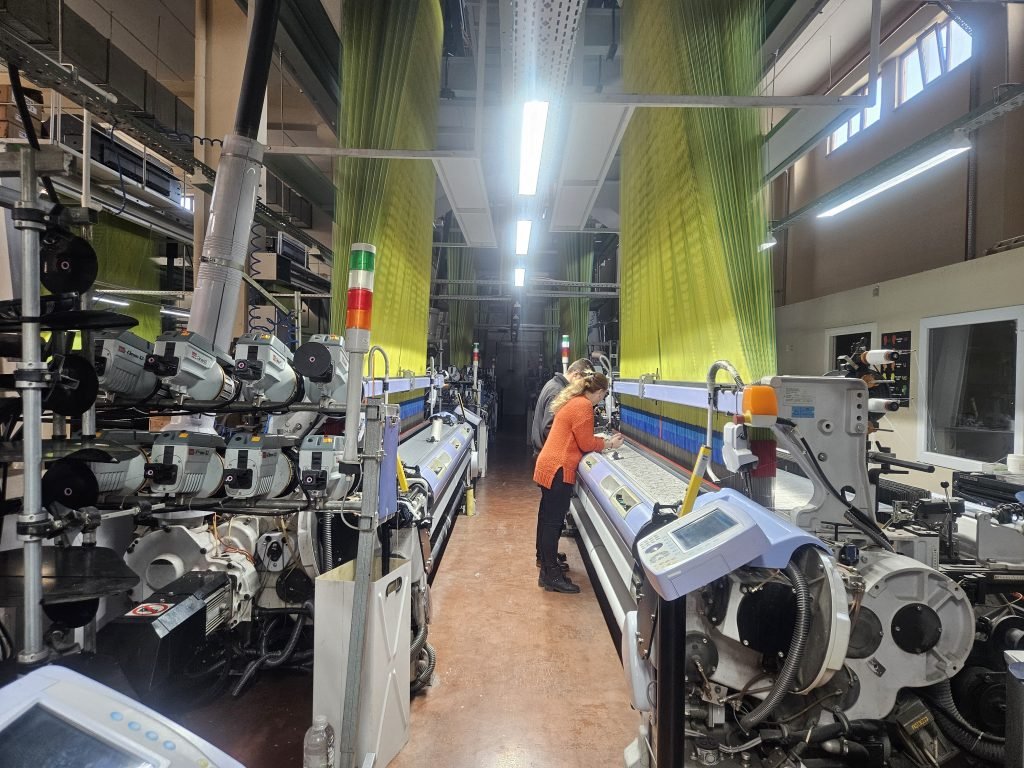
As a result, a wave of bankruptcies has emerged. Some 86 textile companies, including major ones, filed for bankruptcy protection in the first 11 months of 2024. That number was at 240 in 2023 alone. Additionally, some 4,504 textile businesses shut down in the last two years. Employment in the sector dropped by 4,000 in the first half of 2024.
As for the workers who still have jobs in this industry, they often face insecure work conditions and informal forms of employment. Although the unionisation rate in the sector stands at just 8.49%, workers who are unionised are often laid off.
One example is Öznur Mantarcı, who worked for six years in a textile factory’s yarn department. She was dismissed after joining a union. Mantarcı recalls grueling 7.5-hour shifts with only a single 30-minute break, which all culminated into severe physical strain.
“I gave my sweat and years to that factory, and they fired me just for joining a union,” she claims.
Egyptian factories are attracting Turkish firms, according to Ekrem Saraçoğlu, the head of a local union branch. Around 80% of dye houses operate on 12-hour shifts, he says. Workers are then forced to leave home at 7 a.m. and return at 9 p.m. Devoid of a social life, many pick up extra Sunday shifts just to make ends meet.
Even if workers sue for wrongful termination due to union activity, lawsuits last around two years. In reality, laws mandate a resolution within two months. Compensation is indexed to outdated wages, resulting in sums that fail to account for inflation.
In one incident, 150 workers were dismissed over unionisation in a local factory. Out of those 150, 55 filed lawsuits and received union-related compensation. In another case, 16 months’ worth of compensation offered to workers amounted to much less in real terms.
Saraçoğlu warns of a looming employment gap in the wider domestic economy as textile workers leave their industry.
“There’s no sector ready to absorb the job losses from textiles,” he says, while business owners are uncertain about 2025 and expect conditions to worsen.
In the factories, fabric production has shrunk but workloads remain the same, observes Burcu Morkan, a designer at a fabric factory.
“Before the pandemic, we produced at least 100 metres of fabric per batch. Now, that’s the maximum,” she says.
As consumer habits shift, Morkan notices a customer preference for more sustainable, natural fibres. Meanwhile, companies are also pressured to cut prices and quality, she adds.
“We have to think about our costs 40 times before producing a fabric. That’s how tight things are,” she says, noting that 50% of workers are now unemployed.
Sales manager Ömer Kuru notes China’s increasing dominance of the sector. As fabric production costs rise in Turkey, Chinese products are becoming increasingly affordable.
“Electricity, gas prices, inflation – everything has gone up. There’s been a 50% contraction in exports and production in the past two years,” he says.
“Even though the Chinese textile industry bled out during the pandemic, it began to compensate its losses in 2023,” says Enes Özkan, an economist at İstanbul University. He points out that China’s increasing competitiveness is a result of investment in overseas production under its belt-and-road initiative, as well as lower domestic manufacturing costs.
An exporter mostly to the Middle East, Russia, Europe, and the US, Nip Tekstil owner İhsan Pekayla notices customers’ choices shifting to cheaper markets.
“Electricity, wages, taxes – costs are crushing us,” he says. “Everyone is just trying to survive day by day. We hear of bounced checks, more bankruptcies, even among large firms.”
He mentions a company that was once an employer to 600 people, but now employs only 200 workers. The last quarter of 2024 brought serious losses, he says.
“If this continues, April and May will be even worse.”
Pelin Akdemir