
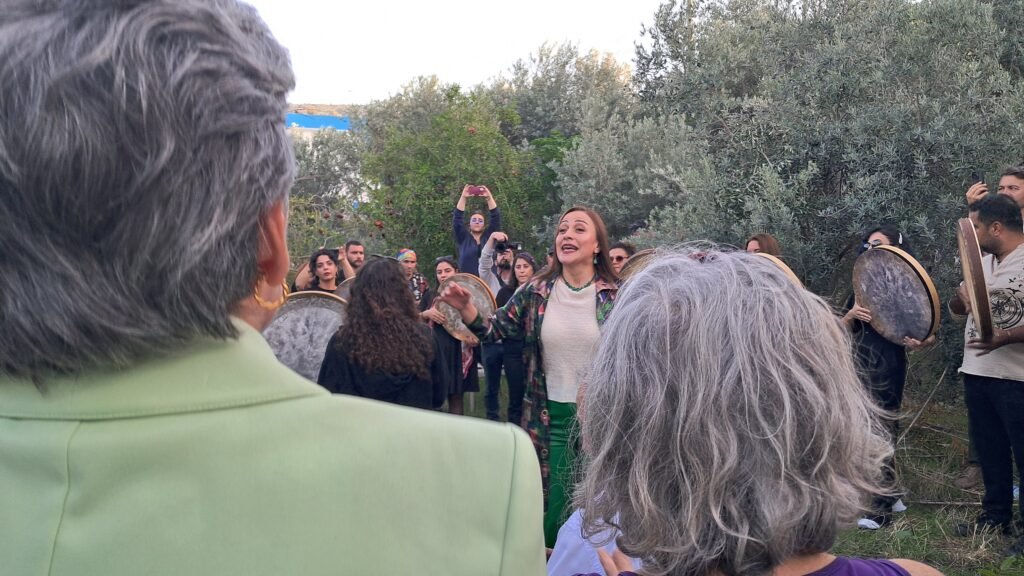
In a courtyard in Hatay, southern Turkey, a group of women are dressed in their best clothes as they get ready for their first concert, after months of practice. They look over the lyrics one last time, the seating chart is finalised and the instruments are tuned. Then, the music starts.
“When we were young,” the conductor Abir Naeseh Bilgin starts singing, as the choir joins in, “how we used to stroll hand in hand on the streets…”
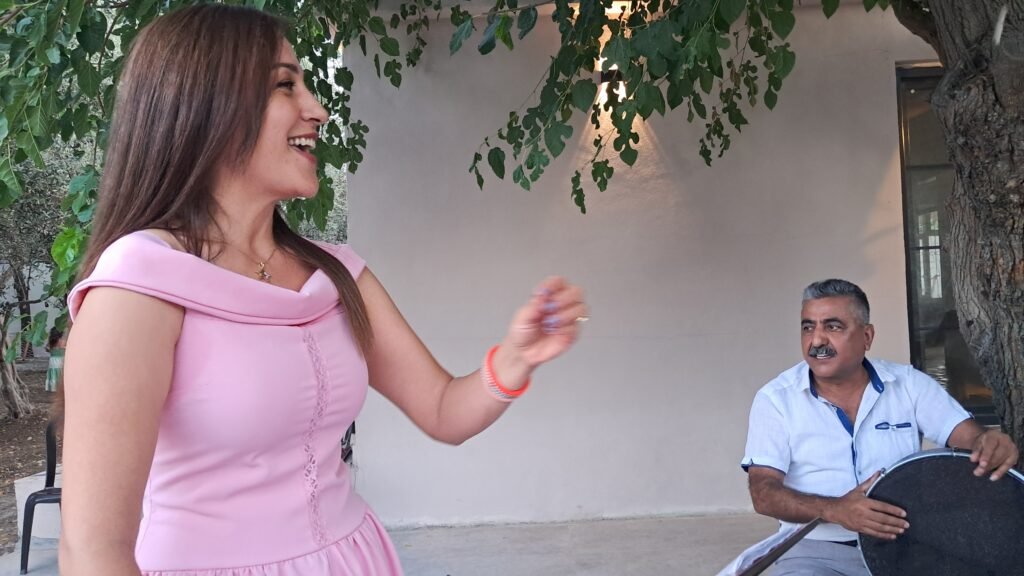
Credit: Burcu Günaydın
Named after the Arabic word for “hello”, the Yahala Arabic Music Workshop was founded in Hatay after the devastating earthquakes of February 2023 that killed over 50,000 people in Turkey and Syria. Some 200,000 people still live in container homes in Hatay, where the electricity often cuts out, transport is patchy and the streets resemble a building site for as far as the eye can see.
On top of these hardships, women struggle with increased caregiving duties, a lack of physical security and grief alongside the demands of daily life. Yahala is one of the rare spaces where women can find respite.
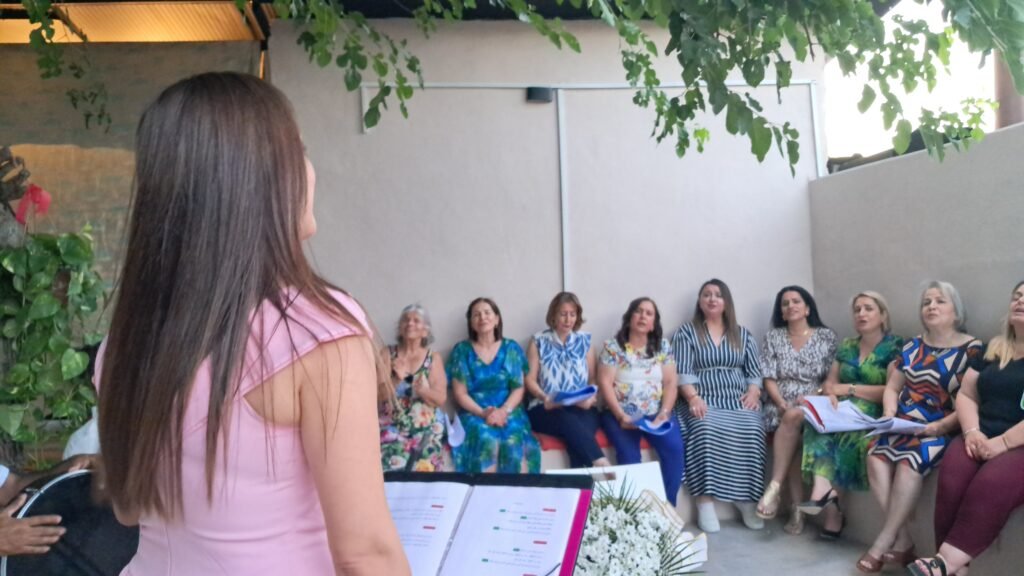
Credit: Burcu Günaydın
Second home
Naeseh Bilgin, one of the workshop’s founders, tells Inside Turkey that she moved to Turkey with her family in 2012, during Syria’s civil war. She was in Hatay’s Antakya district when the earthquake struck nearly three years ago and left the city briefly, but soon returned to what she calls her “second home” with the sense that she “needed to do something”.
Bilgin joined a women’s solidarity group – and it was there, singing along to an Arabic song the other women were humming during a meeting, that the idea for the workshop arose.
Bilgin says she thinks the singing has a healing role, reminding the choir and the audience of songs they might have learned from their relatives.
“After one of our concerts, someone from the audience came up to me and said ‘I saw my father up on that stage today,’” Bilgin says. She mentions another woman, who told her she had joined the workshop in memory of a brother she lost.
“There are many stories like that,” she says. “We sing and learn new songs, while remembering those we lost. We find solace in the songs, in each other.”
Out of the rubble
Members of the workshop often make difficult journeys across the earthquake-scarred region to take part. A retired teacher, Lümeys Dede, lives in a about half an hour outside downtown Antakya. She has to commute through heavy construction traffic to get to rehearsals, but she says she doesn’t mind.
“We lost our joy after the earthquake, we’re trying to find it again,” Dede says.
“I didn’t care what I wore before this choir, I thought ‘to hell with whatever I put on my back,’” she says, thinking back to how she felt after the earthquake. “But now, I found a beaten up iron I dug out of the rubble, I take out and iron my best clothes to come here.”
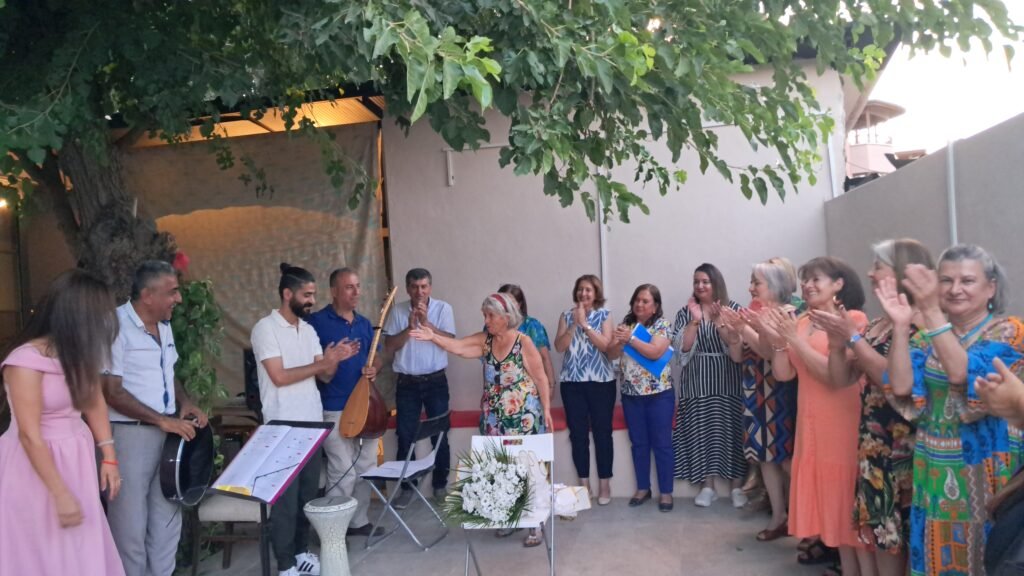
Credit: Burcu Günaydın
Like Dede, who usually sings the choir’s long-form solos and ululation, Gülden Çiçek also faces a long commute to get to rehearsal. If she can schedule around it, she takes her work’s charter bus, otherwise she hitchhikes. A widow of many years and the mother of a disabled son, Çiçek considers her time with the choir “therapy”.
“Sometimes I can’t get a lift and I’m late, but I still want to be there,” Çiçek says. “This workshop is the kind of place where you’ll arrive sad, but leave happy.”
Yahala has performed in Antakya many times and also took part in a concert by the well-known singer Candan Erçetin in October.
“If you told me I’d sing on the same stage as Candan Erçetin one day, I wouldn’t believe you,” Çiçek says with a smile. “We hadn’t had rain in Hatay for months, but it rained during that concert and a rainbow came out. It was an incredible moment for me, I’ll never forget it.”

Credit: Burcu Günaydın
Life remains difficult
The February 2023 earthquakes affected 10 other provinces alongside Hatay and drastically altered the lives of millions. Women have faced particular challenges.
“We covered basic needs through aid in the initial emergency period but things were much harder after a while, especially for women,” says Hülya Kavuk, who works with the Earthquake Solidarity Association and the Antakya Women Stronger Together Platform.
Caregiving duties and tough living conditions were not the only struggles women faced, Kavuk says, noting incidents of sexual harassment in the container housing developments.
“After three years, life remains very difficult in the earthquake zone. The streets are dark, security is an issue. We have severe issues with access to basic needs like education, transportation, health, water and electricity. Unfortunately, women bear all of the burden of these difficulties,” she says.
Kavuk adds that more support from the government is needed.
“Public services need to expand, it is quite important and valuable for women to feel stronger together,” she says. “Women get stronger when they socialise with each other, produce together, spend time in each other’s company.”
Finding security
Psychologist Gülşen Çokluk, a trauma specialist, says that collective activities such as singing are examples of “switching to security mode when faced with danger”. The human brain struggles individually to carry trauma but it calms the nervous system to gather with people who speak the same language, who share the same pain and hope,” she says.
Credit: Burcu Günaydın
Çokluk says that when societies suffer disaster, people often survive by turning to their cultural heritage. The Arabic music workshop strengthens women’s connection to their roots and revives a feeling of “remembering who they are”.
“Women get to experience ‘just being a woman’ without the burden here,” Çokluk says. “Some of them pour their pain into the songs, some their longing or their hope. The city might have collapsed, but these activities show that culture, memory, rhythm and solidarity stands.”
Yahala member Dede agrees with her. “I lost a lot of friends,” she remembers after the concert. “But I try to be as cheerful as I can be when I’m with the choir, because I want to make other people happy. We’ll heal while singing and being together.”
Burcu Günaydın