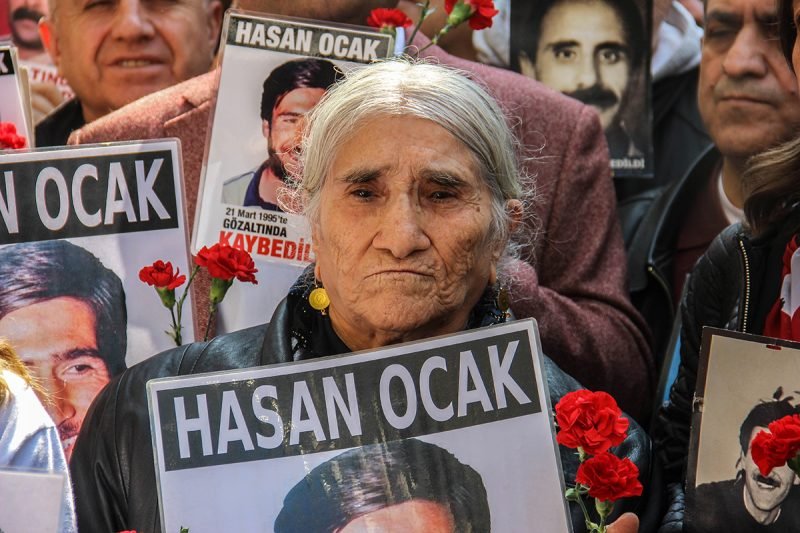

Emine Ocak vividly remembers the day her son’s body was found.
She was 60, and it was 1995, one of the most violent years in the conflict between the Turkish state and the Kurdistan Workers Party (PKK). Political, military and economic crises engulfed the country.
Her son, Hasan, a 30-year-old teacher, had disappeared after being arrested. The family spent nearly two months trying to locate him, before tracing his grave to a nearby field. They dug out his badly decomposed body and gave him a proper burial.
“I thought I would hear my son’s voice again one day, but when I learned that his dead body was found… my world was destroyed,” Ocak said.
The discovery of Hasan’s body, as well as that of another detainee called Rıdvan Karakoç, spurred the families of others who had disappeared in the aftermath of political crackdowns to take action. Ocak, along with workers at the Human Rights Association, a Turkish NGO, and other families began a sit-in protest in front of the Galatasaray High School on Istanbul’s popular Istiklal Avenue on May 27, 1995.
“We were four to five families at first,” said Ocak. “Then we became ten, and then 20, and then 30 families. Then we realised that there are many families like us.”
More than 24 years later, the so-called Saturday Mothers are still waiting for answers.
The group carried out its sit-ins for 200 weeks, before suspending them for nearly a decade due to harassment by security forces. They resumed in January 2009, including children of the detainees who were raised without their fathers, meeting each Saturday at noon holding red carnations and photographs of their relatives. In August last year, they were banned once again.
Inspired by the Plaza de Mayo Mothers in Argentina, who wanted to know the whereabouts of their children who had disappeared under the military dictatorship, their aim was to discover the fate of their loved ones, many of whom were detained in the 1990s amid a crackdown on the Kurdish-majority southeast of the country.
Gamze Elvan