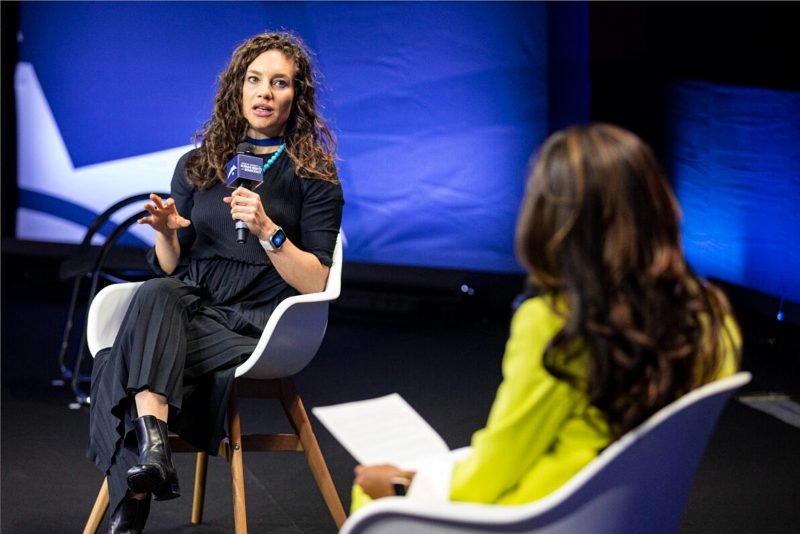

Nevşin Mengü, one of Turkey’s few powerful female journalists, has been broadcasting on social media for some time now after a long career in mainstream media. Moreover, Mengü, who seems to have broken free from the oppressive cycle of ratings-bosses-power, is making a success of it: she is among the most-watched journalists in Turkey.
Mengü’s experience of social media, however, shows that success doesn’t nt her an escape from sexism in journalism, or in society at large. Being a woman journalist in Turkey means being something of an open target.
We talked to Mengü about what it means to be a woman journalist in Turkey.
Every day since 2013, you have anlaysed the news on your YouTube channel “What Happened Today?” You were revealed to be the country’s most-watched YouTube journalist in a survey published by Marketing Turkey, but there were only two female journalists in the top ten. Why do you think popular female journalists are so rare?
It is much more difficult for women to surpass men in YouTube viewership rates, because as women we face character assassination more often. It must be easier to call women “loose” because we are attacked more frequently by government trolls. We are seen as an easier target. When we look at viewer and follower numbers, it seems that [many] people want to get their news from men; they want to listen to men, they trust their word more.
A strong woman, or a woman in a position of authority are not very popular models of “womanhood” in our society. You are a woman who can set the agenda and whose broadcasts have high viewing figures. Could it be that your success alone makes you a target?
Maybe. “She knows too much,” they say. “She gets involved in everything, she has an opinion on everything.” A man who is older is seen as more trustworthy. Men just go all in, they say whatever they want, nothing happens. When I say something a little sharp, the gates of hell swing wide open.
What is the rate of criticism you receive related to your gender? Do you feel that the criticism is motivated by sexism?
Of course I do, but I don’t know what the situation is like for male journalists. I haven’t asked Fatih Altaylı about it, for example. I don’t know if he also receives sexist comments and messages, but I do. But I don’t care too much. If you worry about these things, you can’t do your job. If you’re going to worry “Oh no, what did they say?”, you should do another job. You have to say “Oh well” and move on, otherwise it won’t work. There is no room for vulnerability in this profession.
Another type of discrimination is also very common in the sector and that is ageism. Someone recently wrote to Uğur Dündar: “Enough, dinosaur man, leave this job.” Whether you like it or not, this man was a journalist when you were a baby. Recently, there has been a perception that “if you are young, you are good”. [Dündar] doesn’t present news on a state channel, he broadcasts on his own on social media. Some people feel the need to intervene even in that.
I associate it a little bit with the “new right” climate in Turkey. It exists in the world too: young male fascism. There is a trend of attacking everyone who is not “them”.
As a woman who is in front of the cameras almost every day, do you feel the pressure to look “beautiful”? Can women be as comfortable in front of the cameras as men?
Of course I feel the pressure to look beautiful. I mean, this is how it is. When you are in front of the camera, you have to have charm. “The camera has to like you,” they always tell us. At the least you need to be well groomed. Of course, a man’s job is much simpler in this regard. If he does nothing, if he shaves, gets a haircut and puts on a shirt, that’s it. But for a woman, hair, clothes, everything has to be beautiful and well groomed itself.
Is journalism in Turkey particularly sexist? Or is journalism a male-dominated profession regardless of country or culture?
I cannot say anything for the world, but as someone who works and lives here, I can say that the journalism profession in Turkey contains sexism. Is there any field in Turkey that is not sexist? There isn’t.
Maybe not in the world either, what do you think?
Of course there isn’t. Let’s take the case of Gisele Pelicot: the world is shaken by Dominique Pelicot drugging his wife for 10 years and letting different men rape her. In our morning editorial meeting, our friend Cansu talked about the sexism present even in coverage of that story. Even though the woman asked for the case to be heard in open court, not once do the cameras show the husband or the other male rapists. They only show the woman, and the newspapers still only print her photo. The men are nowhere to be seen. Even in this situation, the woman continues to be an object of spectacle.
You have also worked in the field, as a reporter in difficult places like Tehran. Did you observe sexist attitudes from either your colleagues or the public?
I experienced such behaviour a lot when I was a young reporter. Especially in conservative societies, women are not treated the same way as male journalists. I encountered a lot of things, from those who hesitate to communicate with a female journalist to those who try to belittle a woman on the basis of her gender. Of course, these attitudes have disappeared now that I am a better-known journalist, but in the early days of my profession, I encountered a lot of these attitudes.
Do managers sometimes select jobs and favour female employees in their own way?
Yes, but for example, it is difficult to decide to send a female journalist to Syria. She may even be sexually assaulted there.
But you also worked in Tehran for a while.
Yes, but everything would have been much easier if I was a man. First of all, you wouldn’t have to worry about whether you cover or uncover your head. People would be more willing to talk to you. My job would be a hundred percent easier.
What has changed between when you started your career and now?
Over more than 20 years, I have worked in the field, in the control room, in newspapers and on television. I have been at every step on the ladder, like everyone else in our industry. Journalism is a profession with difficulties. It’s that kind of sector.
Television, in particular, is a place that broadcasts 24 hours a day. It doesn’t change when the work shifts to digital; you have to work and follow [the news cycle]. Because Israel’s bombing of Lebanon is not determined by your child’s bedtime. What I mean is that women in the profession are not only pushed in certain directions, they also make choices.
When a woman becomes a mother, she might prefer not to work with the uncertainty of time and location. After becoming a mother, a woman might not want to say, “Let me go and follow the war in Ukraine for a month.” This is a two-way dynamic: Not only are women undesired, but women may not desire it.
I am not a mother, I am just interpreting this as an outside observer. Media is a challenging sector, it’s not realistic to aspire to being a mother, spending time with your family and being a good reporter all at the same time. If I had a child, I wouldn’t be as active in journalism as I am now. At least that’s what my experience tells me.
Emel Altay