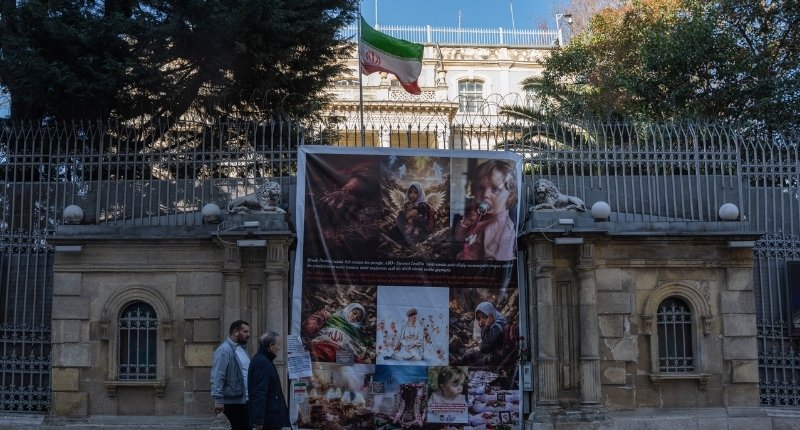
For many, the crisis is shaped by bitter arguments over what kind of change – if any – should come next
In a coffee shop on a chill Ramadan evening, three Iranian friends scroll through their phones and share the latest news with each other. The clink of cups mixes with the constant buzz of phone alerts as their conversation shifts between Turkish and Farsi.
“I even wake up at 3 am to check the news,” said Nima, a 37-year-old engineer.
For many Iranians living in Turkey, the Iran crisis is not only a geopolitical story but an intimate one, shaped by anxious calls to family members, endless scrolling through social media and bitter arguments over what kind of change – if any – should come next.
Their reactions also reflect Turkey’s own uneasy position: a neighbouring state trying to avoid a refugee influx and wider instability while maintaining a delicate balance with both Tehran and Washington.
Nima and his friend Pouya are from Tabriz, the capital city of East Azerbaijan Province in northwestern Iran. Like millions other in the region, both identify as Turks, with Turkish as their mother tongue. With a population exceeding 30 million, the Turks of Iran constitute one of the country’s strongest communities.
Credit: Ingrid Woudwijk
The region had suffered widely from the Persianisation policies implemented by the last Shah Mohammed Reza Pahlavi’s regime, aimed at political and cultural oppression, and the Turks of Iran played a critical role in the 1979 Iranian Revolution.
Nima noted that, unlike in Tehran and other Iranian cities, there was little support for the return of Reza Pahlavi, the son of the last Shah, in Tabriz.
Pouya said that he understood why people supported the revival of the monarchy.
“It’s not like they’re saying that the Shah is a great guy with great promises,” he continued. “Most of them believe there is no other alternative. And the others choose to remember only the good parts of the past. But it’s not realistic. Why did we have a revolution if everything was great before 1979?”
Even though both friends disagree with the Shah’s supporters, they empathise with the demand for change.
“The regime also made major mistakes,” Nima says. “Especially during the Mahsa Amini protests, or during the latest ones. But supporting a foreign intervention in your own country is not the solution.”
“We also don’t love the regime, but we don’t want it to collapse like this,” Pouya concluded.
Nazanin – from Tehran but living in Turkey for more than seven years – is more optimistic.
“I know that in the end, the people of my country are not going to see the kind of democracy and freedom they truly deserve, but I am hopeful about the events taking place,” she said.
Even though Nazanin is nervous about not being able to communicate properly with her family and friends back in Iran, she believes that the Shah can lead a transition period if the regime collapses.
“The only thing that gives me hope is the complete dismantling of Islamic rule in Iran and the formation of a secular republic or monarchy,” she said.
“IT CANNOT BE WORSE THAN THIS”
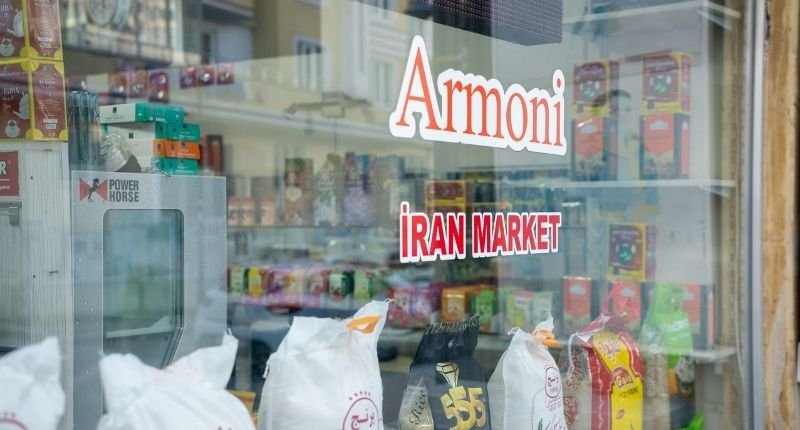
Hamidreza’s shop, on the so-called Iran Street in the western outskirts of Istanbul, is filled with specialities like sangak flatbread, Persian sweets and traditional clothing – although he has received no fresh supplies since the start of the war.
Hopeful about the end of the Islamic Republic, he hands out little date sweets called nan khormayi to celebrate the death of Ayatollah Ali Khamenei, killed in an airstrike on the first day of the war.
Credit: Ingrid Woudwijk
“It cannot be much worse than this,” Hamidreza insisted, arguing that Pahlavi could lead the way to a free and secular Iran.
Hamidreza left Iran seven years ago and said that he tried unsuccessfully to convince his sister to join him for the duration of the hostilities. Iranians can stay in Turkey visa-free for 90 days, and although there are no flights, three land crossings remain open. Though Iranians continue to cross into Turkey, most are dual citizens who travel onwards to a third country.
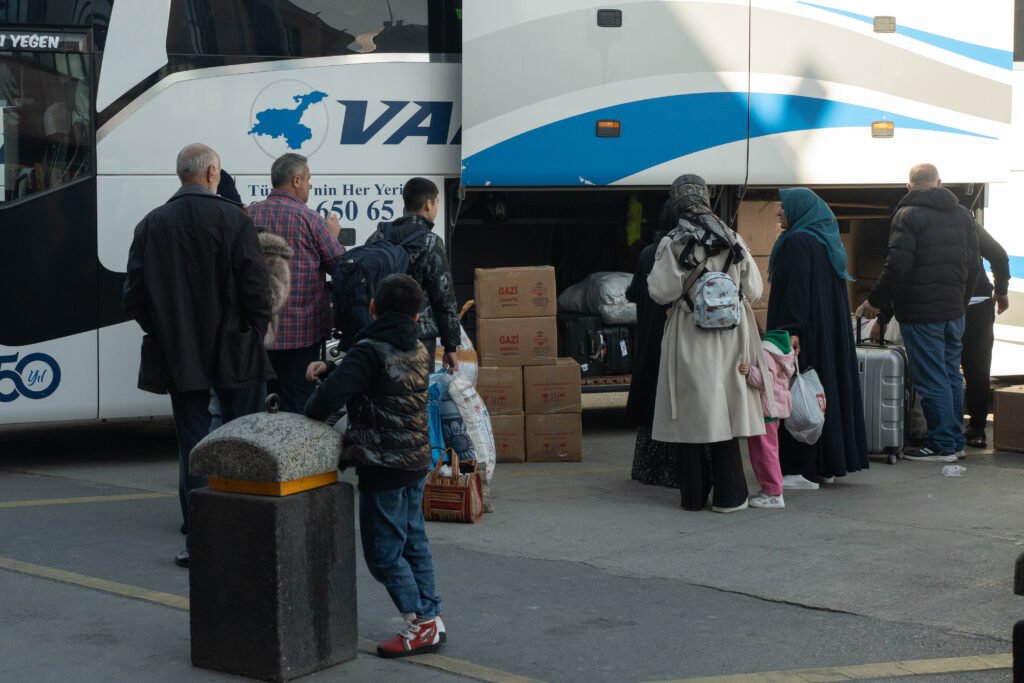
Some still take the journey the other way around. One young Iranian student from the UK was about to board a coach to the border city of Van at Istanbul’s Esenler Bus Station, along with a dozen other Iranians. He said he was traveling home “for his family and his country”.
“We want justice,” he added, declining to give his name.
Beyond political divisions, many Iranians abroad say the hardest part is watching events unfold from afar while their families remain in danger.
For Sapideh, an Iranian psychologist who has lived in Turkey for nearly three years, the emotional toll is clear.
“It’s very hard because you don’t really know what’s happening there,” she said. Internet shutdowns and patchy connections mean many Iranians abroad struggle to reach relatives back home.
“People are constantly exposed to painful images, news and stories, yet they feel they have little control over what’s happening,” she explained.
The strain has also intensified debates within the Iranian diaspora, where sharply different political views often collide.
“Iranians abroad are a large and diverse community, and come from different backgrounds and political viewpoints,” Sapideh said. “Sometimes this difference can lead to debates and tensions; however, at the same time, we have a strong shared feeling and help each other.”
The war also places Turkey itself in a delicate position as tensions grow across its eastern border.
Turkey – a NATO member closely linked to the US – nonetheless shares a long history with Iran and maintains political, economic and cultural ties with its neighbour.
Karabekir Akkoyunlu, a researcher at the University of London’s School of Oriental and African Studies who specialises in Turkey–Iran relations, said Ankara wanted to stay out of the conflict while preserving its ability to communicate with both sides.
“Turkey’s priority is, first and foremost, to protect its own borders and not to get sucked into this war, and so far, it seems to have done a good job,” he said.
On the other hand, while Ankara’s ability to shape the conflict directly remains limited, Akkoyunlu believes that it could have a potential role in any future talks.
“Turkey’s position and Erdoğan’s relationship with both sides might give it some window for being at least a site of mediation and allow it to continue the balancing act and avoid being dragged into the conflict,” he said.
According to Akkoyunlu, public opinion in Turkey appears broadly opposed to the war, and this sentiment cuts across political lines. At the same time, he notes that the conflict is often viewed through simplified narratives.
“A lot of people don’t really have a full view of the extent of repression in Iran,” he said. “The narratives are very simplistic, often bringing the explanation down to imperial designs and Mossad’s machinations, and not giving enough agency to what’s going on the ground.”
In Ankara, a diplomatic balancing act unfolds in the background. In Van, on Turkey’s eastern border, the war has more tangible effects.
“Iranians are indispensable for the people in Van,” explained Erkan Afşar from Van Yüzüncü Yıl University, noting that the conflict is already hurting the city’s economy.
Hotel reservations and tourism activity have dropped sharply since the start of the war, affecting sectors ranging from accommodation to restaurants and retail.
Despite fears of a refugee influx, the crossings at the border have been relatively steady since the beginning of the war, and no illegal waves of entry have been reported.
Afşar explains that the geography and security of the border make large-scale crossings difficult.
“Currently, there aren’t many people who try to cross the border. Even if they try it, the conditions won’t allow them,” he said, noting that the mountainous terrain, harsh winters, and new border walls make crossings far more difficult than along Turkey’s southern frontier with Syria.
Credit: Ingrid Woudwijk
Still, he warns that a prolonged war or internal instability in Iran could eventually trigger a larger wave of migration.
As the war continues to unfold, Iranians in Turkey remain caught between distance and attachment, following every update on their phones while waiting for the next message from home.
Sapideh, the Iranian psychologist, noted that the Persian New Year holiday of Nowruz would have been overshadowed this year.
Traditionally, Iranian families gather around a haft-sin table, where symbolic items representing life, growth and rebirth are carefully arranged.
“Nowruz is about happiness and starting again,” she said, her voice breaking during the interview 10 days before Nowruz. “But it’s difficult, especially when you’re abroad and away from family.”
Even though it didn’t feel like a celebration this year, she still tried to keep her hopes up.
“All the items on the haft-sin table represent life,” she continued. “Maybe this year we should prepare it again, to remind ourselves that we can start again, and to show [people] that we can deal with this.”
Gonca Tokyol & Ingrid Woudwijk
Gonca Tokyol
Ingrid Woudwijk