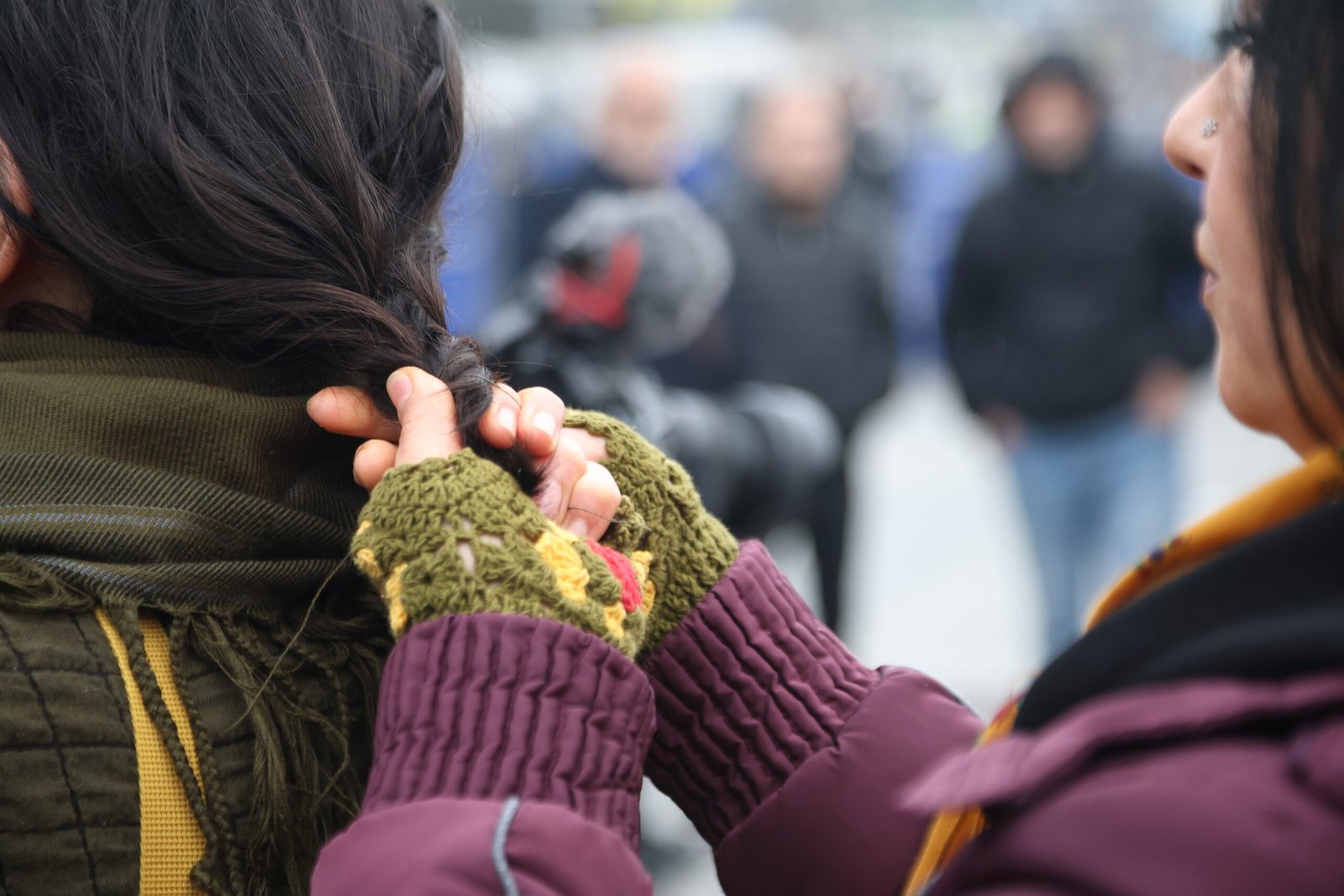

Women’s willingness to alter their hair in solidarity with those suffering violence is “an alternative method of writing history”.
In early 2026, as Syrian government troops retook territory held by Kurdish-led forces in the north of the country, a chilling video circulated online.
A Syrian government soldier was seen holding plaited hair in his hand, claiming he cut it from a female member of the SDF, the Kurdish-led army, who had been killed.
“This is what’s left of her,” he said.
The shocking footage prompted Kurdish women and their allies to protest, sharing videos of themselves weaving their hair into plaits, known as “kezî” in Kurdish.
Beginning in Iraqi Kurdistan, the protest quickly spread to Turkey and internationally, with women sharing images and videos of them silently plaiting their hair on social media.
“I plaited my hair, like other women around the world,” said Rojbin Bor, an activist living in eastern Turkey’s Van province. “As I did so, I felt this: You killed a Kurdish woman fighter and cut her hair off, yet as a Kurdish woman, I am here and my plait is here.”
Bor said that she was particularly moved by online footage of mothers plaiting their daughters’ hair.
“That gave a clear message,” she said. “[Resistance] didn’t end with those you killed. We have other girls who will continue to walk this path.”
This was not the first time hair had been central to a protest in the Middle East. In Iran, in 2022, protests after the death in detention of Mahsa Amini saw women removing their veils and cutting their hair. In Iraq, Yazidi women have protested against killings by the Islamic State by laying their cut-off plaits at the graves of their loved ones.
Muhammed Kaya, an anthropologist at Bremen university in Germany, said that hair had great symbolic power, with societal norms around cutting and shaping it formed around religious rules and cultural values. For anthropologists, hair was a stark symbolic transition between the human body, nature and culture.
“Hair is more than just a physical element, shifting it into a language of identity, belonging and social norms,” Kaya explained. Kurdish, Yazidi and Mesopotamian cultures share a common language in which hair is used to express both grief and identity, he continued, adding, “Plaiting hair in protest displays a desire to unite a fractured society.”
“It is the transformation of grief into collective solidarity. Cutting women’s hair is not just physical violence, but symbolic. So, symbolic acts involving hair are not reactions within Kurdish society,” Kaya concluded. “It is an alternative method of writing history.”
Human rights defender Eren Keskin argued that the hair-plaiting protest should be seen as not just an emotional reaction, but a demand for justice, since mutilation of a body – not to mention cultural desecration – can be categorised as a war crime.
“It is a humanitarian duty to combat violence, torture and humiliation against women, regardless of the perpetrator or the recipient,” she said. “There is no excuse for it.”
CRACKDOWN
In Turkey, the protests prompted an official backlash. Turkish authorities, which treat expressions of Kurdish identity with suspicion and regard the Kurdish-led forces in Syria as a branch of the banned Kurdistan Workers Party (PKK), launched legal proceedings against women who participated.
In western Turkey, a nurse was detained and dismissed from her job after being targeted on social media. In western Turkey, a 17-year-old girl was detained in a house raid for sharing footage of plaiting hair on social media, and is still in jail.
After female fans of the Kurdish football team Amedspor plaited their hair in the stands during a game, the club’s chair, Nahit Eren, was referred to the Professional Football Disciplinary Board.
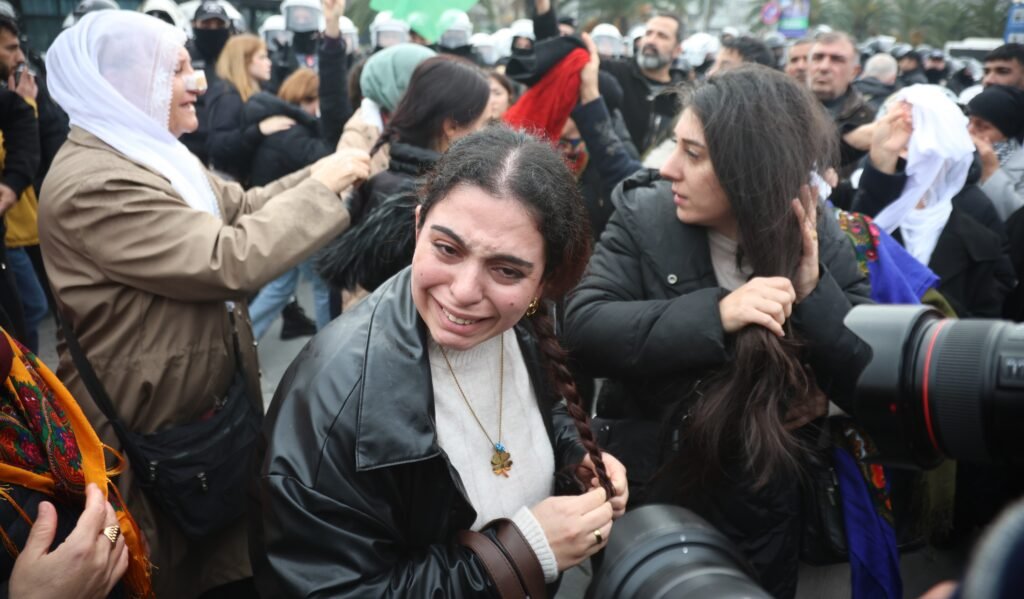
Credit: Erdoğan Alayumat
Player Çekdar Orhan was similarly referred to the disciplinary board for “ideological propaganda”, for plaiting his hair after scoring a goal.
“It is beyond the bounds of law to define a woman plaiting her hair on camera as ‘conducting propaganda for an organisation’,” said Keskin, who is also a lawyer. “The real crime is using women’s bodies as tools of war.”
IMPACT
In February, SDF commander Mazloum Abdi appeared alongside representatives of the Damascus government during meetings held on the sidelines of the Munich Security Conference, signalling a cautious new phase of dialogue between Kurdish authorities and the Syrian state. While the talks did not resolve core disputes over autonomy, governance or security, analysts noted that they reflected growing international pressure to stabilise the region following years of conflict.
Observers of the Kurdish movement say the visibility of civilian-led actions, including women’s protests, helped shape the broader political atmosphere in which those talks took place.
Pro-Kurdish DEM Party lawmaker Adalet Kaya argued that the collective mobilisation, particularly by women, played a role in reframing the conflict beyond military terms.
“Civilians, artists, athletes and journalists came together, but it was women who created a strong awareness of what was happening in northern Syria,” Kaya said. “That visibility affected how the issue was discussed internationally.”
Sociologist Dicle Ayşegül Sayyiğit, from the Rosa Women’s Association in southeastern Diyarbakır province, agreed that women’s willingness to alter their hair in solidarity with carried a strong political message.
She argued that the widespread participation in the protest was not coincidental, but a result of collective memory.
“The reason why this protest resonated with so many women is that women around the globe share a collective memory [of oppression],” she said. “It wasn’t just plaits intertwining, but the weaving of a resistance.”
Rabia Çetin